A festival at odds with itself
The 79th Cannes Film Festival unfolded with AI as the dominant off-screen story.
Festival director Thierry Frémaux came out against it, floating a No-AI label for films like those on organic food and wine: “this film has been made without artificial intelligence.”
On the same day, the festival announced a multi-year sponsorship with Meta — a major AI investor — while the Marché du Film’s invite-only AI for Talent Summit gathered studios, investors and startups around exactly the workflows Frémaux’s rhetoric pushes against.
The 79th Cannes Film Festival unfolded with AI as the dominant off-screen story.
Festival director Thierry Frémaux came out against it, floating a No-AI label for films like those on organic food and wine: “this film has been made without artificial intelligence.”
On the same day, the festival announced a multi-year sponsorship with Meta — a major AI investor — while the Marché du Film’s invite-only AI for Talent Summit gathered studios, investors and startups around exactly the workflows Frémaux’s rhetoric pushes against.
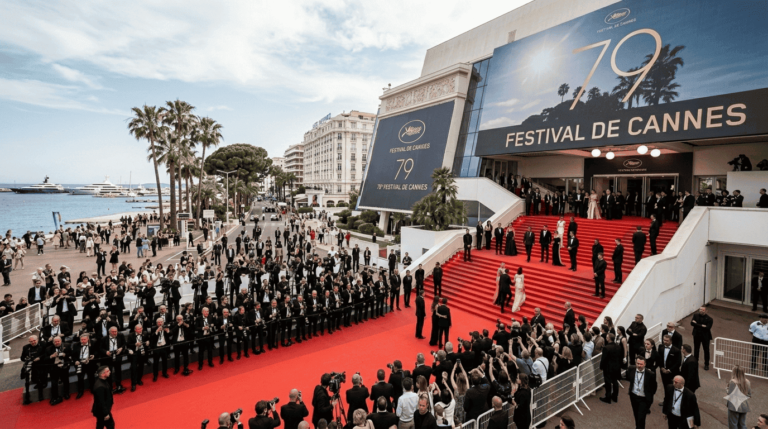
Cannes 2026 Opening (Source: Cinema without Borders, 2026)
No single position on stage
The talent line-up tracked the same split. Opening-day juror Demi Moore called fighting AI “a battle we will lose,” while honorary Palme d’Or recipient Peter Jackson said he doesn’t dislike it at all… “to me, it’s just a special effect.” The contradictions matter because Cannes helps set the tone for how the global industry positions itself, and what it demonstrated is that there’s no single position on AI, even within institutions trying to assert one.
The talent line-up tracked the same split. Opening-day juror Demi Moore called fighting AI “a battle we will lose,” while honorary Palme d’Or recipient Peter Jackson said he doesn’t dislike it at all… “to me, it’s just a special effect.” The contradictions matter because Cannes helps set the tone for how the global industry positions itself, and what it demonstrated is that there’s no single position on AI, even within institutions trying to assert one.
The Cannes premiere that wasn’t
The sharpest test of that came from Higgsfield AI’s Hell Grind, a fully AI-generated 95-minute feature made in 14 days for under $500K (around 80% of it spent on compute) and loudly billed as a Cannes premiere. It wasn’t. The festival confirmed the film was never in its official programme; it played a single third-party screening in the town of Cannes, which Higgsfield defended as part of the “Cannes ecosystem.” The trailer drew near-universal derision, and the headline $50M-vs-$500K saving is the kind of figure that deserves scrutiny rather than repetition.

Higgsfield Original Series (Source: Youtube, 2026)
Conclusion
The wider picture is that Cannes 2026 fits a pattern now visible across the industry: senior figures recognise the AI question is serious, reach for a label or certification as the answer, and stop short of the standard-setting work that would make the label independently legitimised.
Spielberg in March, Frémaux in May, and eight competing “human-made” labels in circulation — each is a real attempt to draw a line, and none of them yet share a definition, a verification process, or a body to enforce them.
The instinct toward transparency is the right one. The execution gap is what the next twelve months need to close.
The wider picture is that Cannes 2026 fits a pattern now visible across the industry: senior figures recognise the AI question is serious, reach for a label or certification as the answer, and stop short of the standard-setting work that would make the label independently legitimised.
Spielberg in March, Frémaux in May, and eight competing “human-made” labels in circulation — each is a real attempt to draw a line, and none of them yet share a definition, a verification process, or a body to enforce them.
The instinct toward transparency is the right one. The execution gap is what the next twelve months need to close.