AIMICI attended IBC 2026 at the RAI in Amsterdam this month, joining as a participant in FRAMES, one of IBC Accelerator’s chosen projects in this year’s cohort. As part of the work, AIMICI exclusively shared their concept AI Transparency and Disclosure Standard publicly for the first time.
Below we share a few quick insights gathered on the ground over the four days at the conference.
AI continues to creep into everyone’s production workflows
Of roughly 980 exhibitors, 140 had an identifiable AI capability. Around half of those touch production directly, the rest sit downstream in distribution, monetisation and playout.
More interesting is how AI reaches a production at all. It often arrives inside ordinary software: media managers, edit tools, localisation vendors, delivery platforms, all already in the budget and already approved. A production can easily be running six tools with AI in them without anyone having taken a deliberate decision to adopt AI. Even for someone with a trained eye to spot AI features can struggle to keep up with tracking their use, especially given the size and distributed nature of most production teams.
How AI governance showed up on the expo floor
The asset-focused side of AI governance has advanced quickly. Watermarking and forensic marking were everywhere, from Synamedia, Verimatrix and Irdeto among others. Sony demonstrated a camera-to-newsroom authenticity workflow with Reuters. NVIDIA showed a synthetic video detector. Loraverse is building lineage into a production engine so that generated assets carry traceable history for legal clearance. Ramblox presented on machine-readable labelling for Article 50 of the EU AI Act – which was seemingly the only presentation on the agenda at the whole conference directly addressing statutory AI labelling. Dalet, Mediagenix, Signiant and Imagine Communications have all shifted their agentic pitch towards governance, selling control over what an agent may touch and who authorised it.
Interestingly, almost none of it was designed for viewing and exploration of the data by humans – moreso to help tech and AI systems gain improved understanding, programmatically & agentically. Watermarking exists to stop piracy, the provenance work for news verification, the agent logs for security. The capabilities are there, yet there seems to be little to no evidence of them being sold to or adopted by non-factual or feature-length productions or teams, despite the benefits they would bring.
What was missing from the AI governance conversation?
Generally, there is an important but slight over-focus on provenance. Yes, tracing assets and how they were produced is useful information for everyone, especially when it comes to concerns around IP infringement. But it feels as though many people in the broadcast tech sphere expect this kind of work to be the silver bullet for solving all AI governance issues.
It is not a simple case of no AI = safe, using AI = risk. Naturally there is nuance. Most of what a production may need to explain to commissioners or insurers about their approach to AI is often not documented at all, nor is it known across a whole team. This may include situations where tools were considered but rejected, decisions to use or not use AI for a task, what AI policies were in force at the time and who approved them, contracts for each performer on how their image and voice may be used by AI tools etc..
Ultimately, we accept that without an appropriate record, no one can verify a statement about AI use on a production, including the team that made it. However, when a production doesn’t commit to providing a statement about its AI use to begin with, everyone working within the production and beyond remains in the dark, no matter how compliant or auditable your records are at a technical level.
“It’s simply not sustainable for production teams to continue with this kind of ‘hear no evil, see no evil’ approach to AI governance. Every film & TV production must be able to easily document and disclose their AI use & AI governance approach to audiences and teams, without any taboo or confusion.” Kathryn Webb, Managing Director, AIMICI
There was no unified solution or approach on offer at IBC for this issue. Instead, an AI performer opened the conference and five synthetic voice vendors exhibited, with no standardised disclosure, consent or likeness governance between them. Given the direction of travel, including the current progress of UK union agreements, that is a notable absence.
The solution? A standard for AI disclosure & transparency.
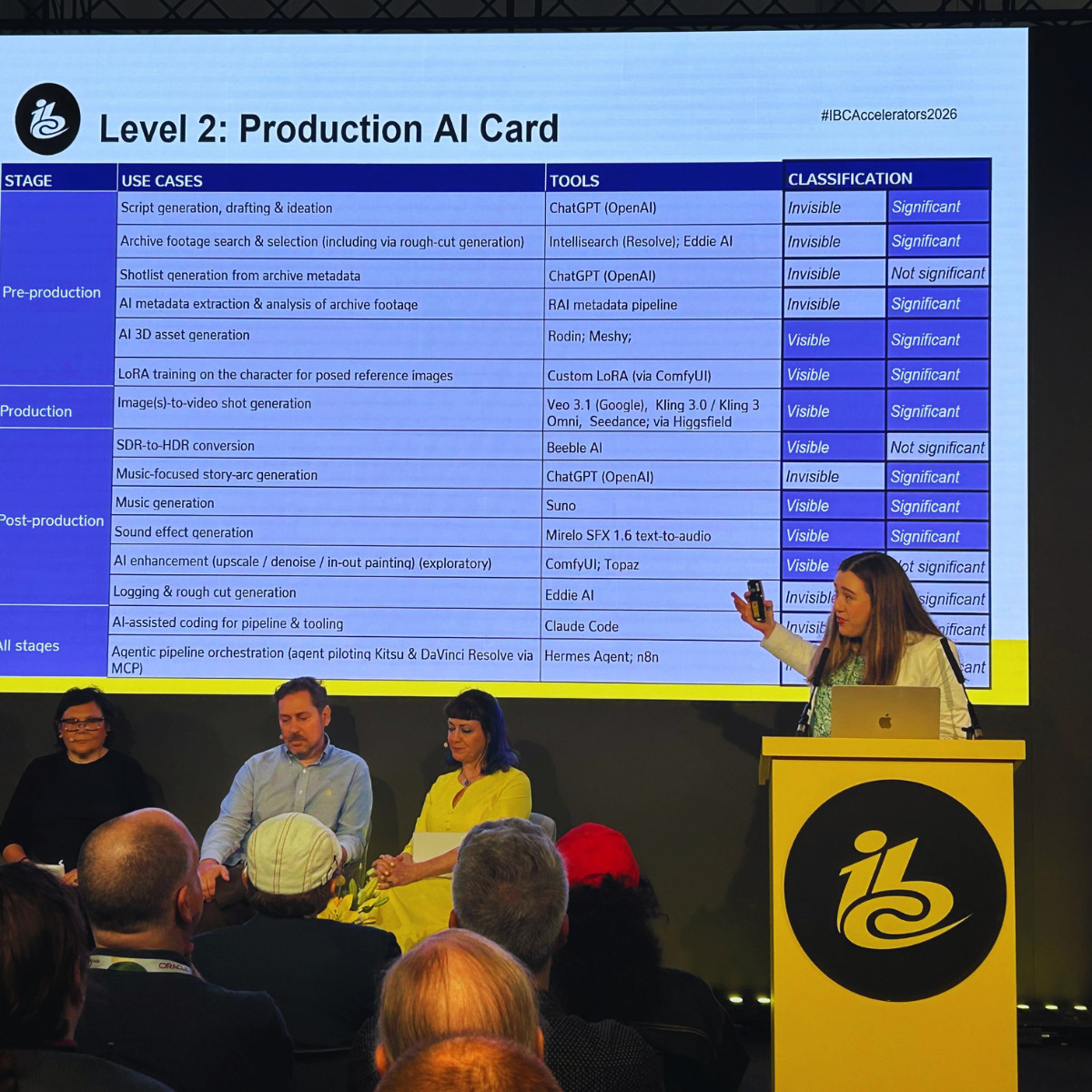
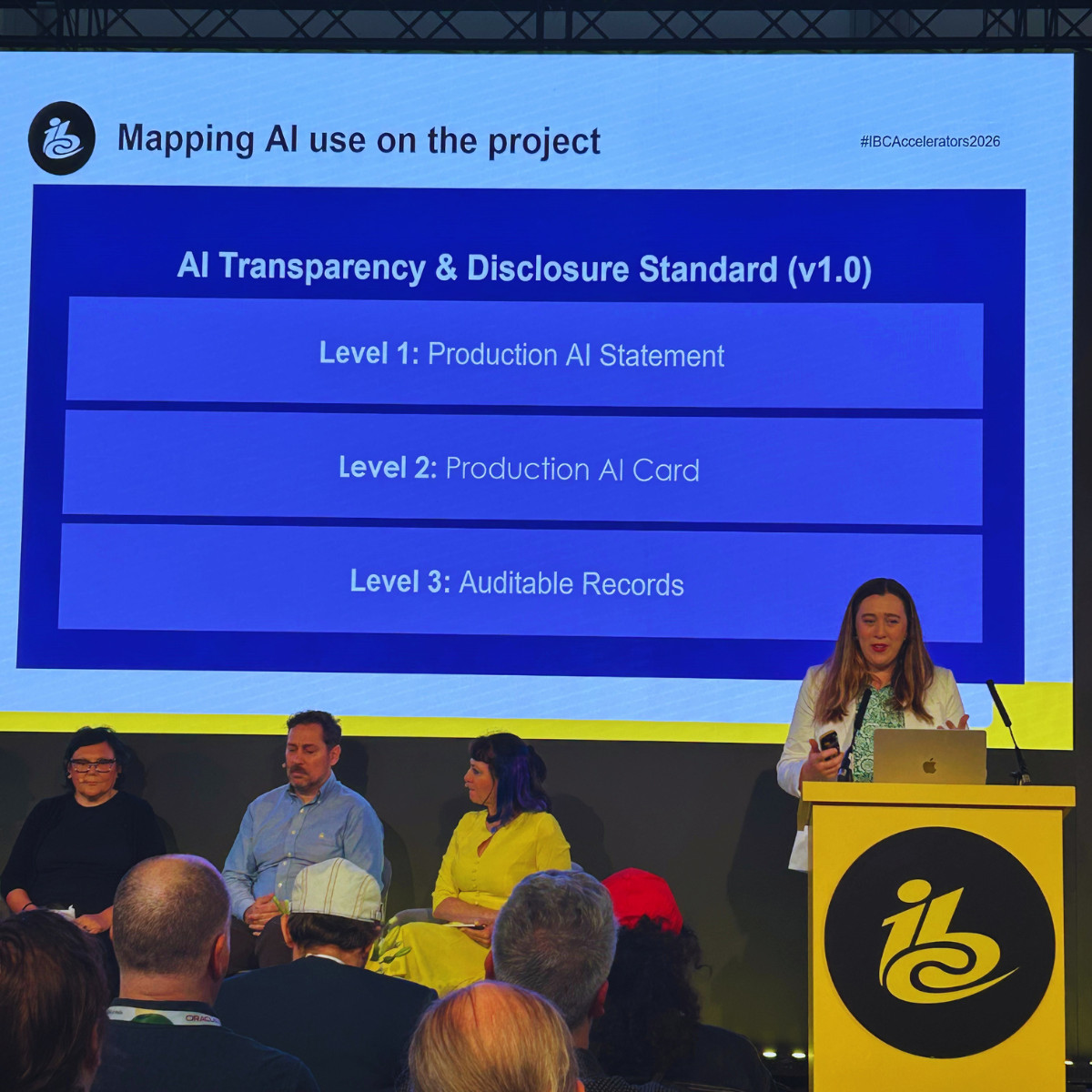
As part of the conference, we shared our new concept for an AI Transparency and Disclosure Standard for film & TV productions. This new standard would act as a blueprint for productions to better organise their information about AI use, and create accessible disclosure documents, aligned with the actual needs of audiences and stakeholders.
Functionally, this works at three levels: a plain-language Production AI Statement for viewing audiences, a one-page Production AI Card for industry stakeholders, and a full Auditable AI Record for auditors and insurers, including the machine-readable marks the EU AI Act requires.
The standard has been developed alongside more than a year of AI governance work delivered by AIMICI, working with both “traditionally made” film & TV productions and hybrid AI-forward productions.
Ultimately, we are moving in a similar direction to existing efforts. For example, the kind of technologies we’re seeing on display at IBC are ideal to create information that would be part of an auditable record (Level 3). But ultimately they are only as useful as they are necessary for both compliance and communications. We hope that our additional suggested formats can help to bridge the gap between machine-level understanding and human-level understanding of AI usage on every production in the near future, as an agreed industry-wide expectation & standard. If you’re interested in supporting this, check out our announcement page for the standard concept for more details or contact us directly at standards@aimici.co.uk.